> ## Documentation Index
> Fetch the complete documentation index at: https://docs.tai42.ai/llms.txt
> Use this file to discover all available pages before exploring further.
# Interactions
> Human-in-the-loop, in-client and external.
An interaction pauses a run to ask a person a question and blocks until they
answer or the question times out. The `ask_user` tool is the core capability: it
suspends the caller mid-run, records the question, and wakes the caller with the
answer.
## The loop
```mermaid theme={null}
flowchart TD
A["a tool or agent calls ask_user"] --> B["record the question,
block the caller"]
B --> C["human sees it on the SSE stream"]
C --> D["human answers"]
D --> E["record the answer,
wake the blocked caller"]
E --> F["the run resumes"]
```
`ask_user` is the engine-agnostic author surface behind the contract's `AskUser`
protocol. Loading it is manifest-driven: opt in the interactions tool module and
the interactions HTTP router, exactly like any other capability.
## Answer formats
A question declares one of five answer formats. Four are answered on an
authenticated **in-client** surface — the caller waits while a person responds
through the answer door:
* **`text`** — free text.
* **`confirm`** — a yes/no acknowledgement.
* **`select`** — a choice from options.
* **`form`** — a typed payload validated against a declared schema.
The fifth format is **`external`**: the human acts on an outside surface — signs a
document, approves a request, pays — and the external system delivers the answer
back through a public callback door. The asking tool blocks exactly as it does for
any other format; only the delivery channel differs.
## Media on a question
A question can carry optional **media** — images and links shown WITH it in the
inbox, above the answer controls. Media is **display-only**: the person still
answers through the question's `answer_format`, and the media never becomes part
of the answer. It is orthogonal to the answer format — valid with every one — and
renders with the question both while it is pending and after it is answered.
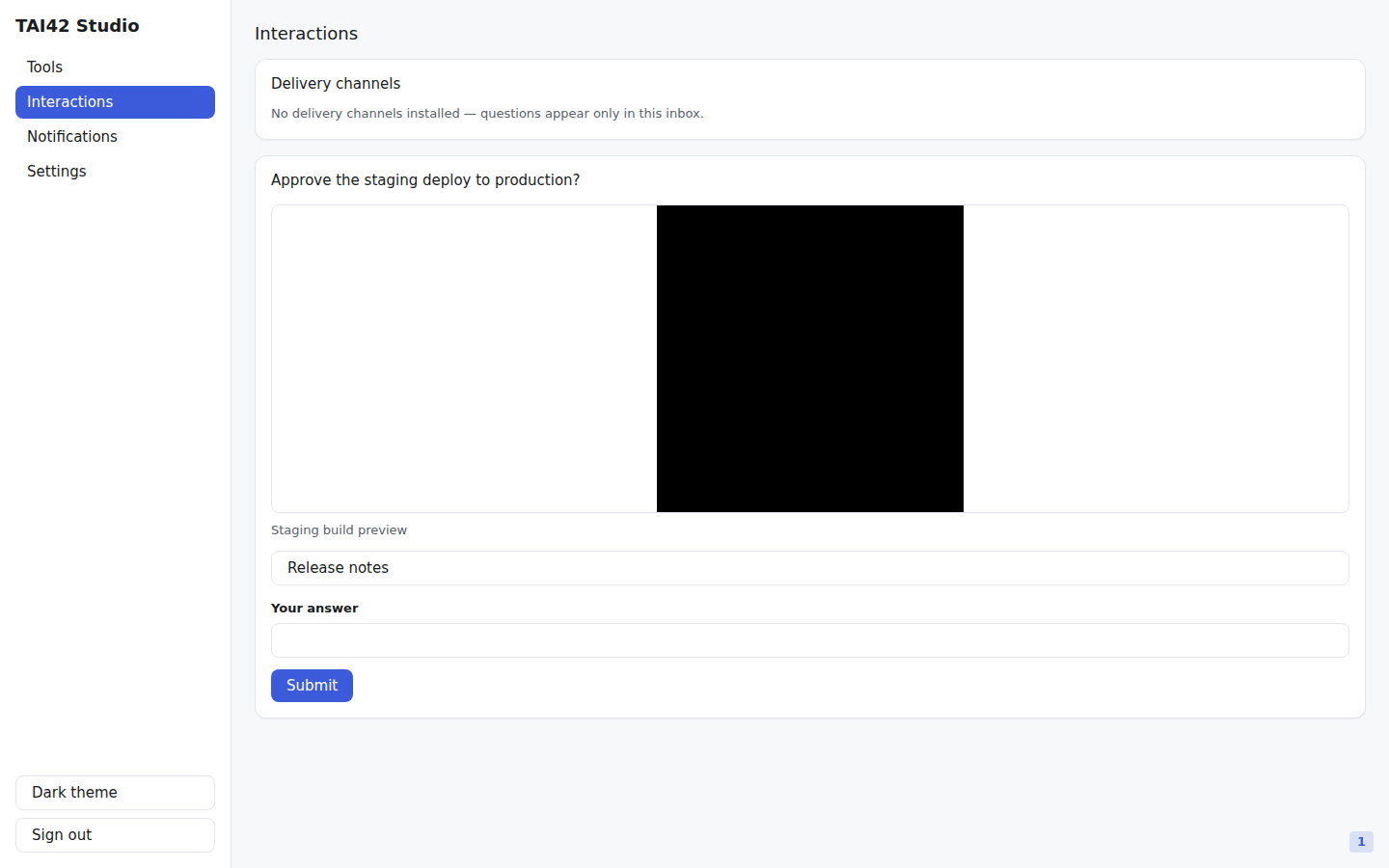
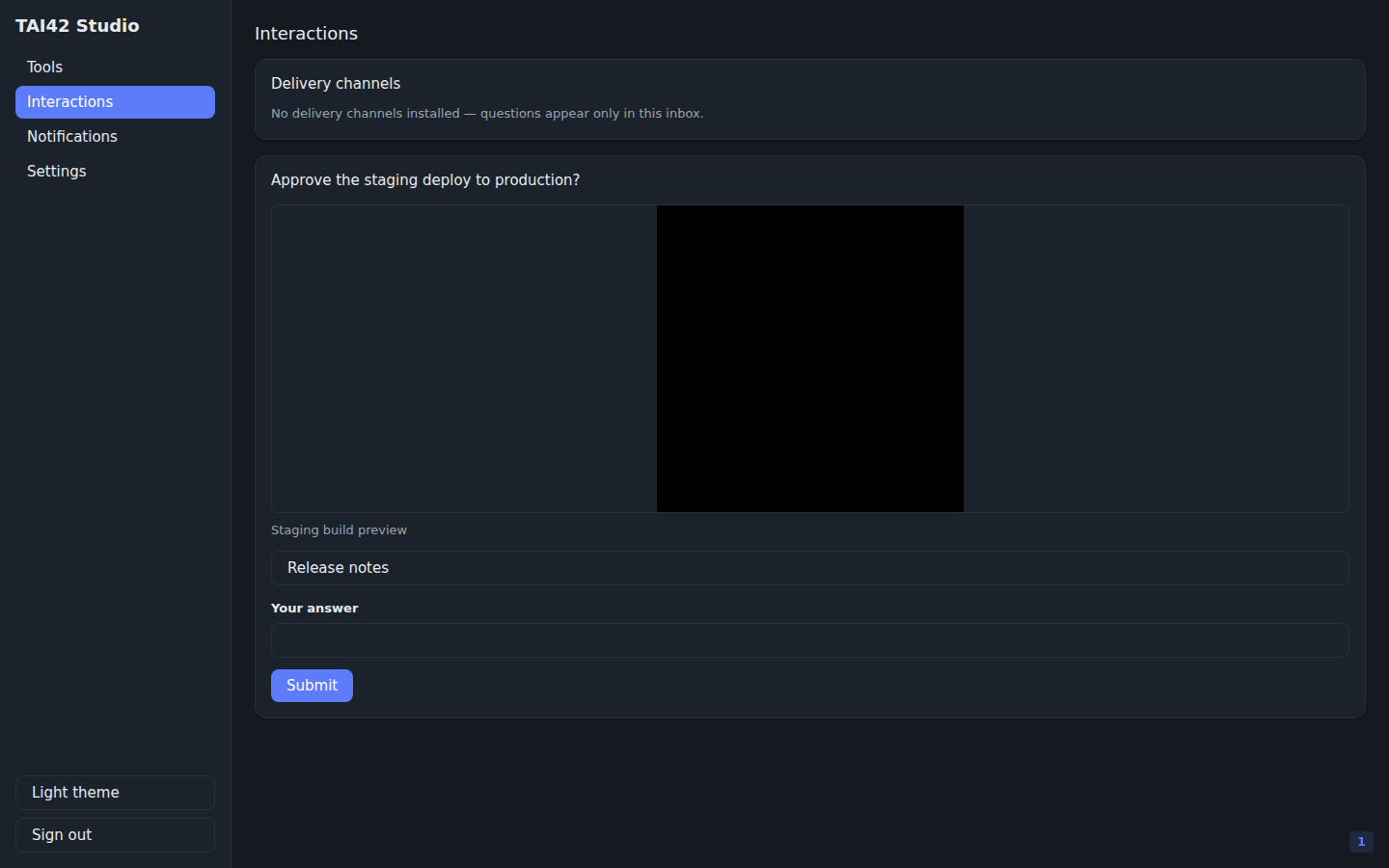 Each item is a `MediaItem` — a `kind`, a `url`, and an optional `caption`:
```json theme={null}
{"kind": "image", "url": "https://cdn.example.com/tote.png", "caption": "The compact tote in sand canvas"}
{"kind": "link", "url": "https://shop.example.com/tote", "caption": "View the compact tote"}
```
* **`kind`** — `image` renders inline; `link` renders as a labelled anchor.
* **`url`** — the source. An `image` is an absolute **`https`** URL or a
`data:image/*` URI; a `link` is an absolute **`http(s)`** URL. Remote images
are https-only: the inbox content-security policy admits `https:` and `data:`
image sources but not `http:`, so an `http:` image would be a record that could
never render — it is rejected up front, not silently dropped. Anchors are not
governed by that policy, so an `http:` link stays valid.
* **`caption`** — optional accessibility text: an image's alt text or a link's
display label.
### Caps
Media is bounded by the contract. These are wire-contract properties — they bound
the durable record and the stream frame it is replayed in — not operator settings:
| Cap | Value | What it bounds |
| -------------------------- | ---------------- | ------------------------------------ |
| `MEDIA_MAX_ITEMS` | 8 | items on one question |
| `MEDIA_URL_MAX_CHARS` | 8192 | one `http(s)`/`https` URL |
| `MEDIA_DATA_URI_MAX_CHARS` | 524288 (512 KiB) | one inline `data:image/*` URI |
| `MEDIA_CAPTION_MAX_CHARS` | 1000 | one caption |
| `MEDIA_TOTAL_URI_CHARS` | 1048576 (1 MiB) | the summed url text across all items |
The per-question total budget is load-bearing beyond the per-item cap: the pending
inbox backlog is replayed whole to every stream consumer on every (re)connect, so a
per-question ceiling bounds a bytes × pending × clients amplification the per-item
cap alone does not.
### Limits
* **Display-only.** Media rides the question, never the answer. The person's
reply carries no media.
* **Not forwarded to channels.** A question always persists to the inbox, where
its media renders. When the same question is also delivered to a
[channel](#delivering-to-a-channel), only the question text is forwarded — the
media stays in the inbox.
* **Privacy.** A remote `https` image is fetched directly by the reader's
browser, which discloses the reader's IP (and request timing) to the image
host. An agent that must avoid that discloses nothing by using a `data:image/*`
URI (the image travels inline in the record) or a same-origin URL the
deployment serves itself.
* **Validated before anything is stored.** Invalid media — an empty list, a
non-`http(s)` link, a non-`https`/non-`data:image` image, an over-cap url,
data URI, caption, or total, a blank caption, or more than `MEDIA_MAX_ITEMS`
items — raises loudly when the question is built, before any state is written.
## External questions
An `external` question requires a `link`. A string link is a template carrying the
literal `{callback_url}` placeholder; a callable link receives the callback URL,
builds the external resource, and returns its final URL. The returned answer is the
payload the callback delivered — a JSON POST body, or the query params of a
GET confirm flow — validated against the question's schema when one is declared.
`ask_external` packages this as a [transformer extension](/concepts/tools-and-extensions):
it wraps a tool that builds an external resource and drives the whole flow. The
wrapped tool takes a `callback_url` parameter and returns the URL to visit.
## Delivering to a channel
By default a pending question surfaces on the authenticated stream — the Studio
inbox. Passing `channel=""` to `ask_user` hands delivery to a registered
**channel plugin** (Telegram, Slack, SMS/WhatsApp) instead: the question mints a
public callback ticket exactly like an `external` ask, the plugin pushes it to
the person on that medium, and the reply comes back through the same callback
door. The asking tool blocks exactly as before — only the delivery leg changes.
An unknown channel name, or a delivery failure, raises loudly before the run
would wait on an answer that can never arrive. See
[Author a channel](/guides/authors/channel).
## The doors
The interactions surface exposes four HTTP doors. Two are authenticated and two
are public:
| Door | Auth | Purpose |
| ------------------------------------------ | ------------- | ---------------------------------------------------- |
| `GET /api/interactions/stream` | authenticated | SSE feed of pending questions |
| `POST /api/interactions/{id}/answer` | authenticated | the human answer door (in-client formats) |
| `POST /api/interactions/callback/{ticket}` | **public** | the data door — sensitive answers ride the JSON body |
| `GET /api/interactions/callback/{ticket}` | **public** | the redirect door — serves a confirm page |
Publicness is an [access-control](/concepts/access-control) configuration decision,
not a property of the route code.
## Security in brief
* **The ticket is the capability.** It is a high-entropy bearer token that expires
on its TTL; single use is enforced by an answered-state guard, and a provider
retry against a live ticket gets an idempotent `200 already_answered`.
* **GET never mutates.** Link scanners prefetch URLs, so the GET door serves a
byte-constant confirm page whose form POSTs back — the human's click performs
the claim.
* **Uniform 404 and no reflected input.** Unknown, expired, and pruned tickets
return the same response; callback pages interpolate no request-derived value.
* **Signature verification** runs in core. Bind a
[webhook verifier](/concepts/triggers-and-webhooks) to an external question and
the POST door verifies the raw body before the answer is accepted — failing
closed.
External questions require `INTERACTIONS_PUBLIC_BASE_URL` (an `https://` origin,
since the callback URL is a bearer capability) and Redis 7.0+. Callback payloads
arrive through an unauthenticated door, so every stream consumer must treat them
as untrusted.
The [use-interactions guide](/guides/use-interactions) walks `ask_user` across the
answer formats and wires an `ask_external` callback end to end. See the
[HTTP API reference](/reference/api/index) for the interaction routes and the
[CLI reference](/reference/cli/index) for `tai interactions`.
Each item is a `MediaItem` — a `kind`, a `url`, and an optional `caption`:
```json theme={null}
{"kind": "image", "url": "https://cdn.example.com/tote.png", "caption": "The compact tote in sand canvas"}
{"kind": "link", "url": "https://shop.example.com/tote", "caption": "View the compact tote"}
```
* **`kind`** — `image` renders inline; `link` renders as a labelled anchor.
* **`url`** — the source. An `image` is an absolute **`https`** URL or a
`data:image/*` URI; a `link` is an absolute **`http(s)`** URL. Remote images
are https-only: the inbox content-security policy admits `https:` and `data:`
image sources but not `http:`, so an `http:` image would be a record that could
never render — it is rejected up front, not silently dropped. Anchors are not
governed by that policy, so an `http:` link stays valid.
* **`caption`** — optional accessibility text: an image's alt text or a link's
display label.
### Caps
Media is bounded by the contract. These are wire-contract properties — they bound
the durable record and the stream frame it is replayed in — not operator settings:
| Cap | Value | What it bounds |
| -------------------------- | ---------------- | ------------------------------------ |
| `MEDIA_MAX_ITEMS` | 8 | items on one question |
| `MEDIA_URL_MAX_CHARS` | 8192 | one `http(s)`/`https` URL |
| `MEDIA_DATA_URI_MAX_CHARS` | 524288 (512 KiB) | one inline `data:image/*` URI |
| `MEDIA_CAPTION_MAX_CHARS` | 1000 | one caption |
| `MEDIA_TOTAL_URI_CHARS` | 1048576 (1 MiB) | the summed url text across all items |
The per-question total budget is load-bearing beyond the per-item cap: the pending
inbox backlog is replayed whole to every stream consumer on every (re)connect, so a
per-question ceiling bounds a bytes × pending × clients amplification the per-item
cap alone does not.
### Limits
* **Display-only.** Media rides the question, never the answer. The person's
reply carries no media.
* **Not forwarded to channels.** A question always persists to the inbox, where
its media renders. When the same question is also delivered to a
[channel](#delivering-to-a-channel), only the question text is forwarded — the
media stays in the inbox.
* **Privacy.** A remote `https` image is fetched directly by the reader's
browser, which discloses the reader's IP (and request timing) to the image
host. An agent that must avoid that discloses nothing by using a `data:image/*`
URI (the image travels inline in the record) or a same-origin URL the
deployment serves itself.
* **Validated before anything is stored.** Invalid media — an empty list, a
non-`http(s)` link, a non-`https`/non-`data:image` image, an over-cap url,
data URI, caption, or total, a blank caption, or more than `MEDIA_MAX_ITEMS`
items — raises loudly when the question is built, before any state is written.
## External questions
An `external` question requires a `link`. A string link is a template carrying the
literal `{callback_url}` placeholder; a callable link receives the callback URL,
builds the external resource, and returns its final URL. The returned answer is the
payload the callback delivered — a JSON POST body, or the query params of a
GET confirm flow — validated against the question's schema when one is declared.
`ask_external` packages this as a [transformer extension](/concepts/tools-and-extensions):
it wraps a tool that builds an external resource and drives the whole flow. The
wrapped tool takes a `callback_url` parameter and returns the URL to visit.
## Delivering to a channel
By default a pending question surfaces on the authenticated stream — the Studio
inbox. Passing `channel=""` to `ask_user` hands delivery to a registered
**channel plugin** (Telegram, Slack, SMS/WhatsApp) instead: the question mints a
public callback ticket exactly like an `external` ask, the plugin pushes it to
the person on that medium, and the reply comes back through the same callback
door. The asking tool blocks exactly as before — only the delivery leg changes.
An unknown channel name, or a delivery failure, raises loudly before the run
would wait on an answer that can never arrive. See
[Author a channel](/guides/authors/channel).
## The doors
The interactions surface exposes four HTTP doors. Two are authenticated and two
are public:
| Door | Auth | Purpose |
| ------------------------------------------ | ------------- | ---------------------------------------------------- |
| `GET /api/interactions/stream` | authenticated | SSE feed of pending questions |
| `POST /api/interactions/{id}/answer` | authenticated | the human answer door (in-client formats) |
| `POST /api/interactions/callback/{ticket}` | **public** | the data door — sensitive answers ride the JSON body |
| `GET /api/interactions/callback/{ticket}` | **public** | the redirect door — serves a confirm page |
Publicness is an [access-control](/concepts/access-control) configuration decision,
not a property of the route code.
## Security in brief
* **The ticket is the capability.** It is a high-entropy bearer token that expires
on its TTL; single use is enforced by an answered-state guard, and a provider
retry against a live ticket gets an idempotent `200 already_answered`.
* **GET never mutates.** Link scanners prefetch URLs, so the GET door serves a
byte-constant confirm page whose form POSTs back — the human's click performs
the claim.
* **Uniform 404 and no reflected input.** Unknown, expired, and pruned tickets
return the same response; callback pages interpolate no request-derived value.
* **Signature verification** runs in core. Bind a
[webhook verifier](/concepts/triggers-and-webhooks) to an external question and
the POST door verifies the raw body before the answer is accepted — failing
closed.
External questions require `INTERACTIONS_PUBLIC_BASE_URL` (an `https://` origin,
since the callback URL is a bearer capability) and Redis 7.0+. Callback payloads
arrive through an unauthenticated door, so every stream consumer must treat them
as untrusted.
The [use-interactions guide](/guides/use-interactions) walks `ask_user` across the
answer formats and wires an `ask_external` callback end to end. See the
[HTTP API reference](/reference/api/index) for the interaction routes and the
[CLI reference](/reference/cli/index) for `tai interactions`.