> ## Documentation Index
> Fetch the complete documentation index at: https://docs.tai42.ai/llms.txt
> Use this file to discover all available pages before exploring further.
# Deploying the Studio
> Serve the built Studio app from the skeleton, with the import map and OAuth-bridge notes.
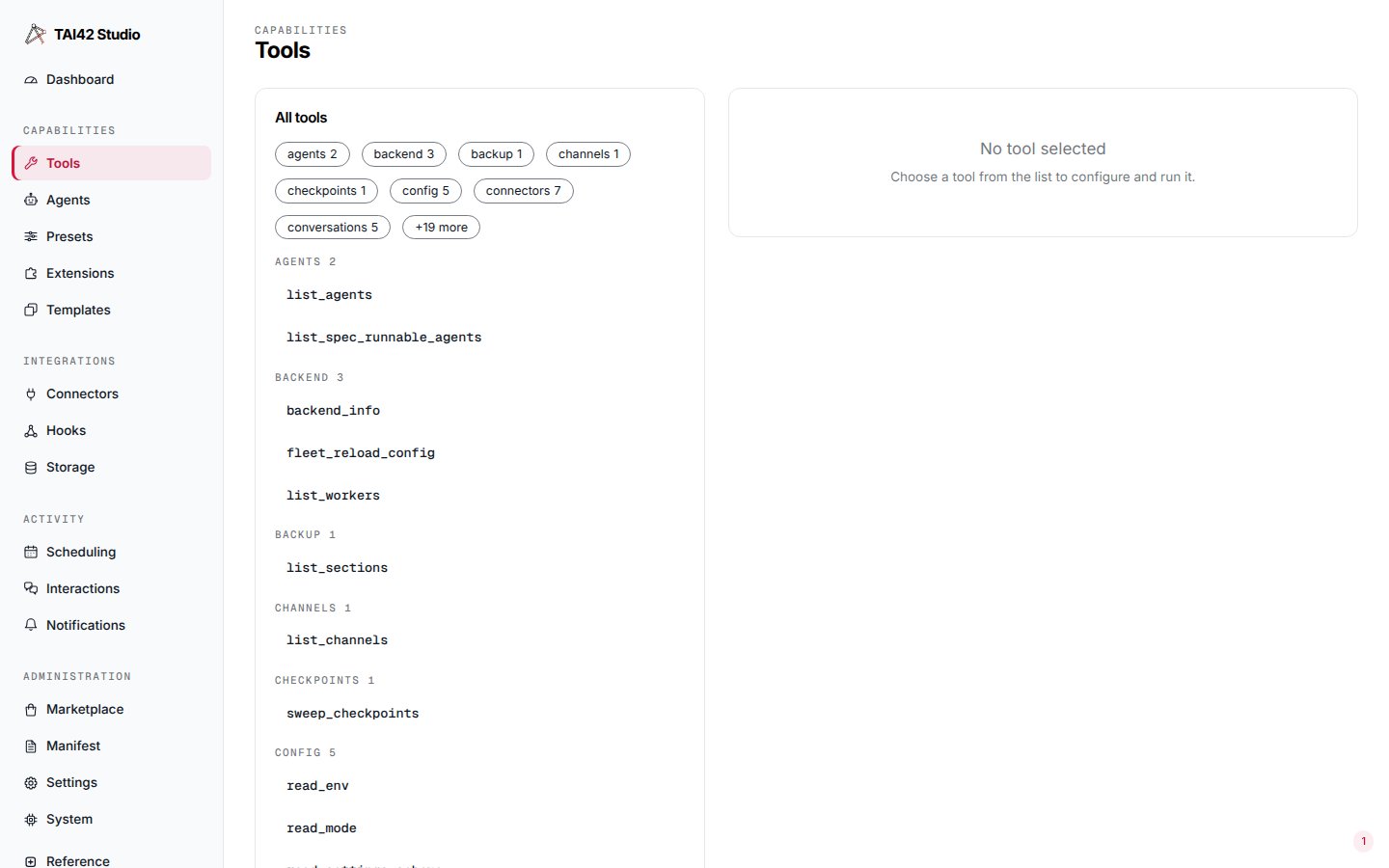
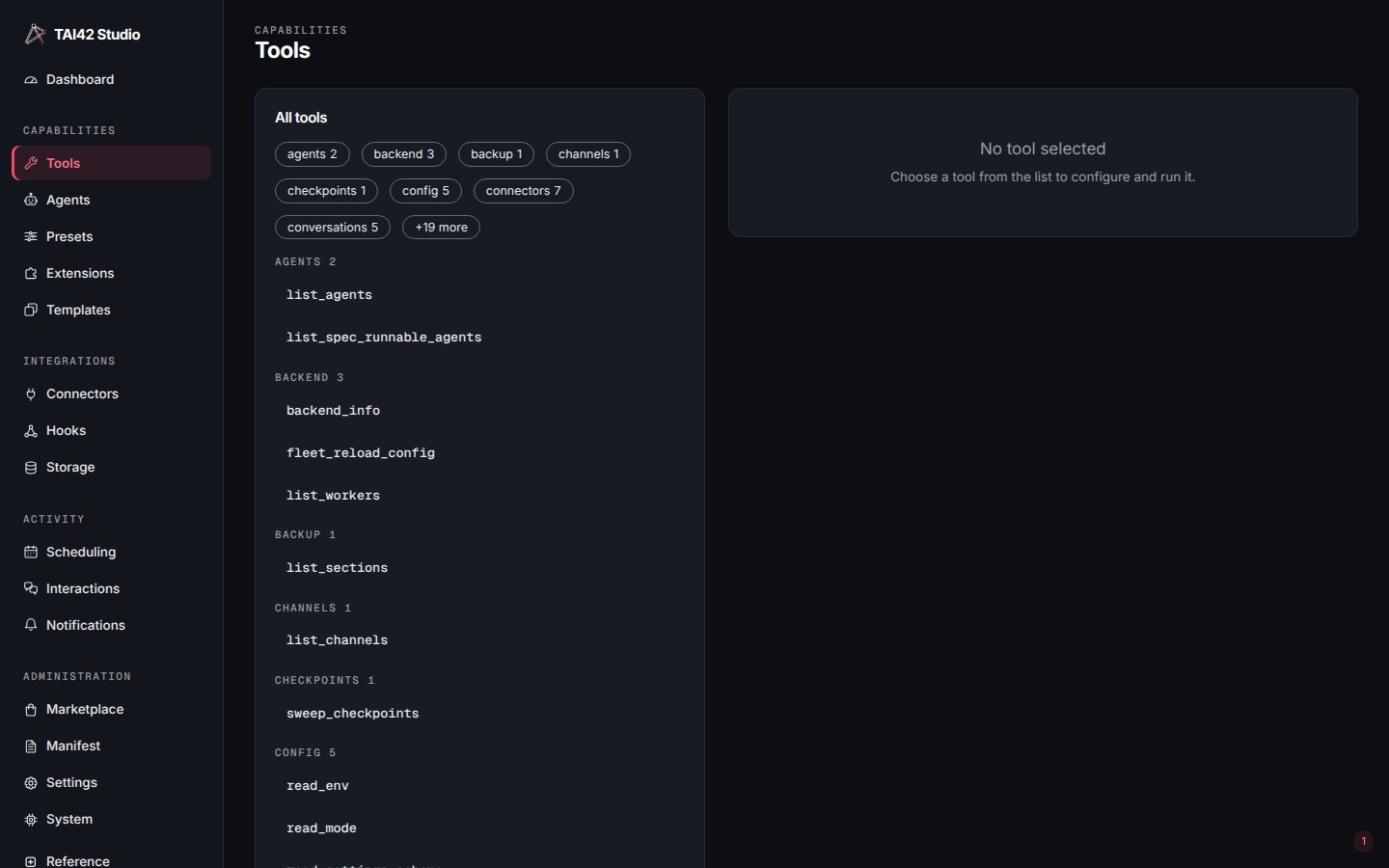
The Studio ships as a static single-page app that the skeleton serves. There is
no separate Studio server to run: you point the skeleton at the built app, and
it hosts the UI on the same origin as the `/api/*` surface the UI drives.
## Serve the built app
Build the Studio to a `dist` directory, then set the skeleton's
`STUDIO_DIST_PATH` (the `studio_dist_path` setting) to that path and start the
server. The skeleton serves the app — `index.html`, the hashed asset bundles,
and the stable `vendor/` modules — under its own origin, with the `/api/*`
routes taking precedence and every other path falling back to the app shell.
```bash theme={null}
export STUDIO_DIST_PATH=/path/to/studio/dist
tai serve --manifest-path manifest.yml
```
 `studio_dist_path` is a per-deployment setting, not [manifest](/concepts/manifest)
content. Leave it unset on a server that does not host the UI — the app route
answers `404` while the path is unset.
## Deep links under access control
With [access control](/concepts/access-control) on, a refresh or bookmark of an
inner Studio route — `/agents`, `/settings`, and the rest — serves the **dataless
SPA shell** (`index.html` and its static assets), not a `404`. The shell leaks
nothing: every piece of data it renders sits behind an authenticated `/api/*`
call, so an unauthenticated visitor lands on the login page. This is on by
default (the `spa_shell_public` setting), so **deep links work without pinning
`/` or any SPA path public** — you do not add the app routes or asset prefixes to
the public-route table. The `/api/*` surface and the control plane are never
served the shell.
A headless / API-only deployment that hosts no UI can turn the fallback off by
setting `spa_shell_public` to `false`. A genuinely public non-`/api` GET route
outside the shell must instead be listed in `acknowledged_public_routes`, which
the boot audits explicitly.
## Why the app must be built and served
The skeleton injects an import map into `index.html` at serve time — the map
that resolves the app's shared modules (`react`, `@tai42/studio-sdk`, and the
rest) and, for a [Studio plugin](/reference/studio-sdk/index), the plugin's
bundle. A statically previewed `index.html` carries the un-replaced import-map
anchor and dies on the first bare import, so a Studio plugin loads only against
a built app the skeleton serves — never under a plain dev server.
## The OAuth-bridge allowlist
[Connectors](/concepts/connectors) that use OAuth redirect through the skeleton,
or through its configured OAuth bridge. When `CONNECTORS_OAUTH_BRIDGE_URL` is set
on the skeleton, the bridge origin **must** also appear in the skeleton's
`CONNECTORS_REDIRECT_URI_ALLOWLIST`.
If the bridge origin is missing from `CONNECTORS_REDIRECT_URI_ALLOWLIST`, every
Connect flow fails closed — the skeleton rejects the redirect and no connector
can be authorized.
See the [deploy guide](/operate/deploy) for running a server for real, the
[serve command](/reference/cli/serve) for the launch flags, and the
[Studio SDK reference](/reference/studio-sdk/index) for building a Studio plugin.
`studio_dist_path` is a per-deployment setting, not [manifest](/concepts/manifest)
content. Leave it unset on a server that does not host the UI — the app route
answers `404` while the path is unset.
## Deep links under access control
With [access control](/concepts/access-control) on, a refresh or bookmark of an
inner Studio route — `/agents`, `/settings`, and the rest — serves the **dataless
SPA shell** (`index.html` and its static assets), not a `404`. The shell leaks
nothing: every piece of data it renders sits behind an authenticated `/api/*`
call, so an unauthenticated visitor lands on the login page. This is on by
default (the `spa_shell_public` setting), so **deep links work without pinning
`/` or any SPA path public** — you do not add the app routes or asset prefixes to
the public-route table. The `/api/*` surface and the control plane are never
served the shell.
A headless / API-only deployment that hosts no UI can turn the fallback off by
setting `spa_shell_public` to `false`. A genuinely public non-`/api` GET route
outside the shell must instead be listed in `acknowledged_public_routes`, which
the boot audits explicitly.
## Why the app must be built and served
The skeleton injects an import map into `index.html` at serve time — the map
that resolves the app's shared modules (`react`, `@tai42/studio-sdk`, and the
rest) and, for a [Studio plugin](/reference/studio-sdk/index), the plugin's
bundle. A statically previewed `index.html` carries the un-replaced import-map
anchor and dies on the first bare import, so a Studio plugin loads only against
a built app the skeleton serves — never under a plain dev server.
## The OAuth-bridge allowlist
[Connectors](/concepts/connectors) that use OAuth redirect through the skeleton,
or through its configured OAuth bridge. When `CONNECTORS_OAUTH_BRIDGE_URL` is set
on the skeleton, the bridge origin **must** also appear in the skeleton's
`CONNECTORS_REDIRECT_URI_ALLOWLIST`.
If the bridge origin is missing from `CONNECTORS_REDIRECT_URI_ALLOWLIST`, every
Connect flow fails closed — the skeleton rejects the redirect and no connector
can be authorized.
See the [deploy guide](/operate/deploy) for running a server for real, the
[serve command](/reference/cli/serve) for the launch flags, and the
[Studio SDK reference](/reference/studio-sdk/index) for building a Studio plugin.